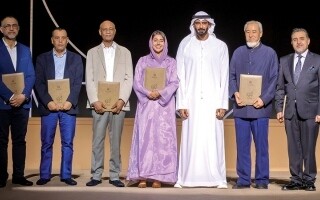
Sheikh Salem bin Khalid Al Qasimi, Minister of Culture, confirmed that the "Al Burda Award" has succeeded, over its past cycles, in spreading Islamic arts with a contemporary vision that preserves authenticity and focuses on innovation, becoming today a global platform that honors creators in the fields of calligraphy, ornamentation, poetry, and contemporary arts. He added that with each new cycle of the award, we consolidate the status of Islamic art as a tributary of cultural dialogue and a platform that expresses the values of beauty, peace, and mutual respect, embodying our message in the United Arab Emirates to support the civilizational dialogue between cultures. This came on the sidelines of the ceremony organized by the Ministry of Culture the day before yesterday at the Louvre Abu Dhabi to honor the winners of the 19th cycle of the Al Burda Award. The ceremony honored a select group of creators in Islamic arts, within the categories of Arabic calligraphy, poetry, ornamentation, and typographic design. This year's ceremony was held under the slogan "Cohesion and Social Solidarity," in line with the "Year of Community 2025," which focuses on enhancing human connection and rooting the values of unity and harmony, affirming the role of culture and arts in supporting social cohesion and consolidating the spirit of harmony and cooperation. This year's participation was diverse, including artists and creators from more than 50 countries around the world, as the award received over 1,300 entries in the categories of Arabic poetry, Arabic calligraphy, and ornamentation, achieving a 23% growth compared to the previous cycle. The ceremony included a comprehensive artistic program inspired by the creative narrative "Beauty in its Entirety," featuring five main musical segments: "The Beauty of Traditions," "The Beauty of Harmony," "The Beauty of Diversity," "The Beauty of Cooperation," and "The Beauty of Unity," in addition to three speech segments centered on harmony and unity, contribution and giving, and growth and prosperity. The ceremony embodied a clear message confirming that beauty lies in the meeting and complementarity of differences, not in their sameness, making the collective presence more beautiful than the sum of its parts. The list of winners in the typographic design category included Suhaim Al Sayegh, who won first place, and Noor Shamsi in second, while Yasmine Naaim took third place. In the contemporary calligraphy category, Muhammad Reza Basheri won first place, followed by Mehdi Zamani Lekani in second, and Najia Farooq Ibrahim Saliman in third. Muhammad Said Nakhshyan came in fourth, and Rehana Koushtakar Qasimi in fifth. In the traditional calligraphy category, Ahmad Al Hawari took first place, while Dr. Bilal Atiya came second, and Maryam Nooruzi Hallani third. Ahmad Ali Namazi secured fourth place, while both Mamdoh Ali and Ijaz Rahim shared fifth place. In the traditional ornamentation category, Mohsen Moradi won first place, followed by Zohra Dosti in second, and then Habibur Rahman Sultani in third. Ilam Golforzi Nafti received fourth place, while both Afsaneh Mehdevi and Ali Reza Abbasat shared fifth. In the contemporary ornamentation category, Nader Tatar won first place, Mehraban Biza Kaya second, and Narges Moomini third. In the classical poetry category, Nshua Jad won first place for a poetic text characterized by the depth of its idea and the beauty of its structure, followed by Imad Abu Ahmed in second, and Hassan Mubarak Al Rubaie in third. Two encouragement prizes were also awarded to Fazila Azimi and Muaz Mohammad Ayyoun. In the Nabati (dialect) poetry category, Hamad Al Mutairi won first place, followed by Abdullah Al Hajri in second, and Abdulaziz Al Omairi in third.
The Pure Biography The Al Burda Award aims to shed light on the pure biography of the Prophet Muhammad (PBUH) and his unique personality by celebrating Islamic arts as a bridge for cultural communication with the world and as part of the common human heritage. It also seeks to highlight the values of tolerance and beauty, encourage innovation and artistic creativity, stimulate younger generations to practice traditional Islamic arts, as well as represent the cultural and intellectual diversity of the Islamic world and attract young, talented, and creative individuals, which supports the global creative movement.
Salem Al Qasimi: "A platform that expresses the values of peace and mutual respect... 1,300 works competed in the categories of Arabic poetry, Arabic calligraphy, and ornamentation."